Lingxiao Luo
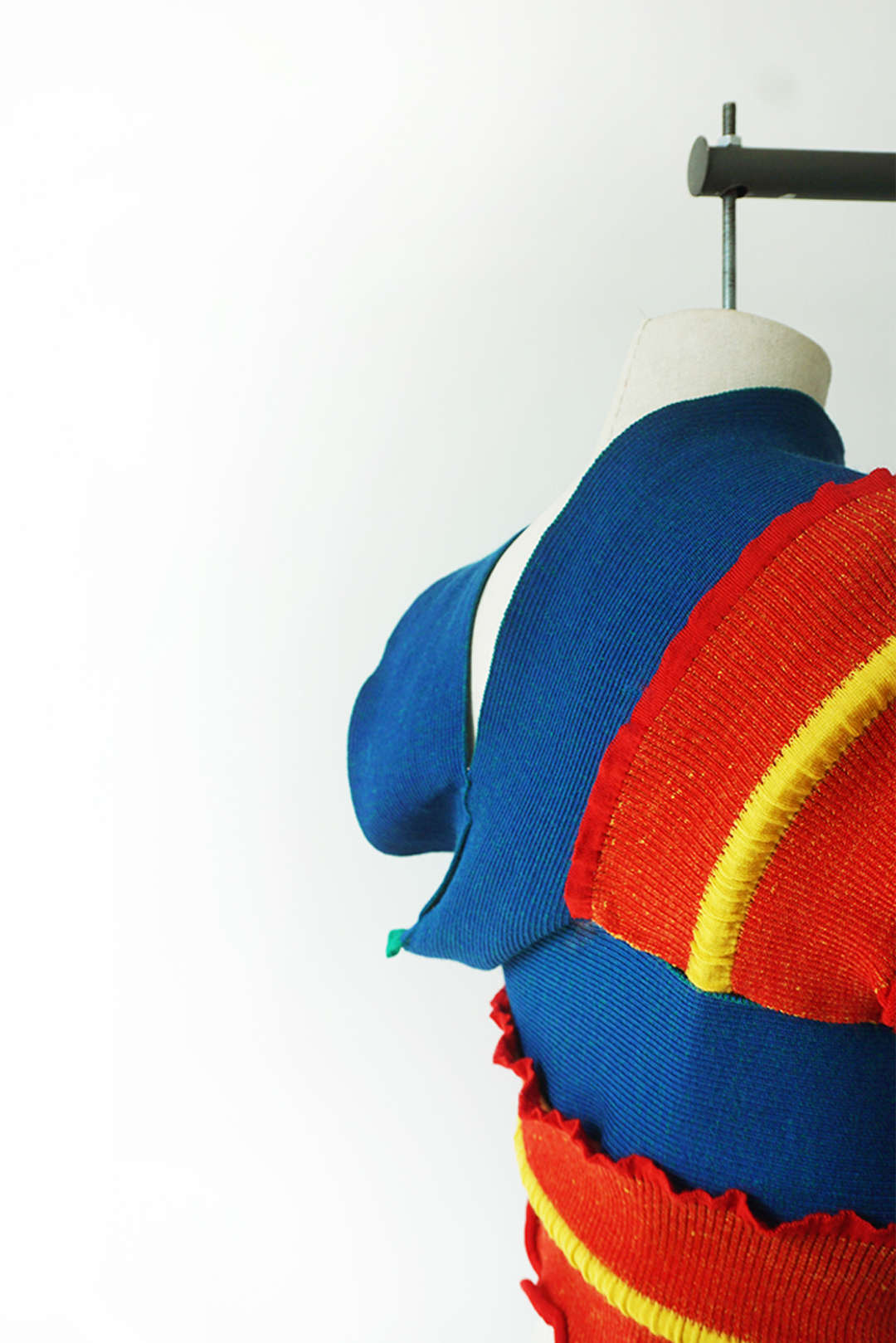
Behaving Knit: design-led integration of soft actuators through knit structure programming
Lingxiao Luo, EU funded Phd prepared at Ensadlab, Ecole des Arts Déco, PSL University in the framework of the SOFTWEAR doctoral network (on-going). Supervision: Aurélie Mosse, Edwin Jager, Benoît Roman .
This thesis investigates behaving knit through a design-led, practice-based inquiry. Situated between textile design, soft actuation, and practice-based research, it examines how knitted construction can move beyond a substrate role to support soft actuation integration and articulate distinct, repeatable, and perceptible textile behaviours. In this thesis, behaving knit is not proposed as a universal category or a single technique, but as a situated design framework for examining how knitted structures can organise behaviour through the relations between yarn, loop, structure, material response, applied force, actuation strategy, and use context.
The research responds to a gap between engineering-led approaches to actuator-integrated textiles and textile design approaches to dynamic or shape-changing artefacts. Soft actuator research often prioritises performance, control, repeatability, and technical integration, while textile and clothing design practices have explored transformation, expressivity, and bodily experience without always documenting how such behaviours are constructed through specific textile techniques. This leaves a need for design knowledge that connects actuation integration, knit structure programming, behavioural legibility, aesthetic articulation, and fabrication responsibility. The research question guiding the thesis is therefore: how can behaving knit be developed through knit-led design inquiry to support soft actuation integration and articulate perceptible textile behaviours?
To address this question, the thesis develops a practice-based design-led methodology through iterative sampling, prototyping, documentation, and reflection. The research unfolds through three main practice trajectories. The first explores folding behaviour in reconfigurable knit, examining how knitted surfaces can stage fold/de-fold transformation, colour revelation, visual rhythm, and touch-triggered movement through the Knit4mation demos. The second develops a pneumatic channel sample library, investigating how knitted channel geometry, density programming, anchoring, routing, tube and bladder selection, and inflation conditions shape swelling, bending, unfolding, and other perceptible behaviours. The third translates selected findings into Embrace, a garment-scale prototype that explores subtle, body-near pneumatic behaviour through compression, enclosure, proximity, and restrained movement.
The thesis contributes to textile design and actuator-integrated textiles in four ways. First, it articulates behaving knit as a textile-design framing for understanding behaviour as a designed quality rather than a mechanical output. Second, it establishes channel-based integration knowledge for pneumatic actuation in knitted structures. Third, it shows how knit structure programming can support behavioural and aesthetic articulation across sample, demo, and garment scales. Fourth, it identifies circular fabrication implications for actuator-integrated knitwear through removable pneumatic elements, reduced permanent bonding, material separation, and knit-led construction strategies. Together, these contributions demonstrate that soft actuation integration, perceptible behaviour, and fabrication strategy can be designed through knitted structure as interdependent concerns.
Dedicated website for the SOFTWEAR doctoral network: https://softwear-dn.eu/
Related publications
- Luo, L., 2025, Behave-Knit: Sustainable Integration of Pneumatic Actuators in Knitted Wearables, In: Proceedings of TEI’25, Bordeaux/Talence France, 4-7th of March 2025, ACM.
- Luo, L. , 2024, KNIT4MATION, In: Tepe, J. (Ed.), 2024. Dialogical Bodies Conference : Proceedings, 19-20th of April 2024, The Swedish School of Textiles, University of Borås, Sweden, p.56

